Norsk Remote Commentary

Stop letting ISDN costs decide which events get commentary — and which territories go unserved

A match that should have commentary but doesn't — because the ISDN-and-codec cost didn't fit the production budget — is not a scheduling decision. It is the infrastructure constraining the editorial. Norsk Remote Commentary is remote commentary software built for exactly this: commentators join via browser, no circuits booked, no codec hardware shipped. Mix Minus handled in software per commentator. Sub-second programme monitoring. If a connection drops live, reconnection is a browser refresh — ten seconds, not an engineering incident. The fourth language channel costs the same to connect as the first.

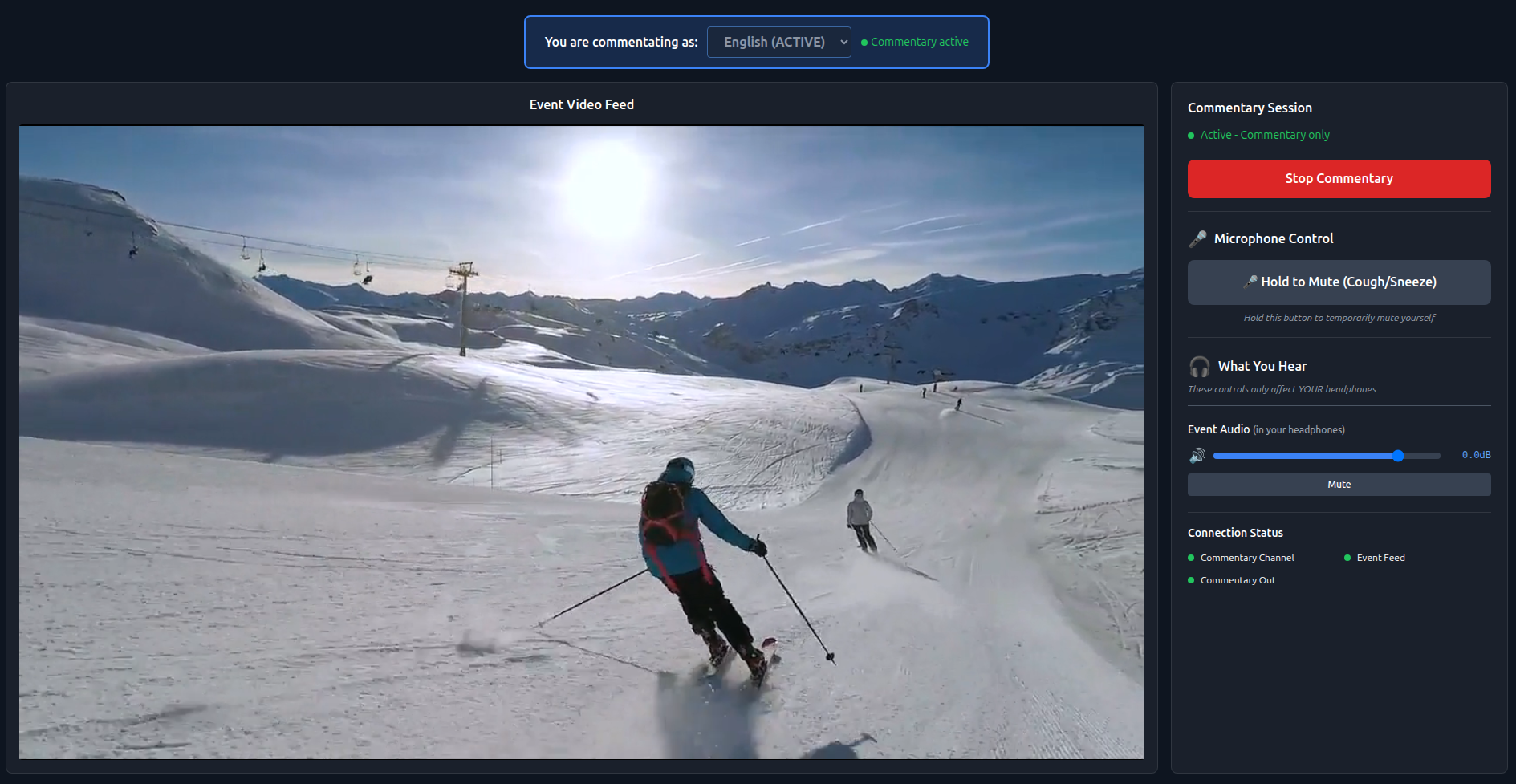
The Norsk Remote Commentary interface

How it works

Send a URL. Commentary on air.

The pre-production sequence that took weeks of logistics becomes a fifteen-minute setup.

Step 01
Send a URL — no logistics before it

Commentators visit a link and join over standard broadband. No ISDN circuits booked weeks in advance, no codec hardware shipped to venues, no specialist software installed, no engineer briefed at both ends. The connection overhead that defined remote commentary pre-production is gone.

Step 02
They hear the event. Not themselves.

Each commentator receives the live event feed — video and audio — with sub-second latency. Mix Minus routes a personalised audio feed to each commentator that excludes their own voice. No echo, no feedback, no dedicated audio routing hardware. The latency is low enough that commentary sounds natural, not compensated.

Step 03
Every language, same setup, same cost

Commentary audio is mixed into the programme output and delivered to your broadcast chain. Multiple simultaneous language channels — English, Spanish, Arabic, any combination — each costs the same to connect as the first. All channels managed and monitored from a single operator interface alongside the rest of the workflow.

Use cases

Where the coverage ceiling gets removed

The operations that benefit most are those making commentary decisions on infrastructure grounds — when the editorial answer is yes and the logistics answer is no.

Sports rights holder

Commentary on every match in the rights package — not just the ones where ISDN economics work

A sports rights holder acquires commentary rights for a full season. They cover roughly half the matches with commentary, because the ISDN-and-codec cost makes the rest marginal on the production budget. Internally it is described as a scheduling issue. It is not a scheduling issue.

With commentary logistics reduced to a browser link and a fifteen-minute test call, the production budget covers every match. The coverage question becomes editorial again — which events deserve commentary — rather than which events can absorb the ISDN overhead.

Talk to us about your setup →
International broadcaster

The territory you stopped saying no to

A rights holder is asked to add a third language commentary feed for a new territory. Adding it means another ISDN circuit, another codec, another engineer slot, and a coordination overhead that does not fit the production fee the territory can support. They decline. That is significant commercial value left on the table.

The fourth language channel costs the same to connect as the first. The territory conversation shifts from logistics negotiation to rights value — which markets are worth serving, not which ones the infrastructure can accommodate.

Talk to us about your setup →
Production company

Replacing ISDN in the client's chain without inheriting its grind

A production company managing remote commentary for multiple clients coordinates ISDN circuits, codec hardware at both ends, and specialist engineers per event — significant capital cost, per-event logistics overhead, and constant exposure to failure modes in physical infrastructure they do not control.

Commentators connect via browser from home or studio. No codec hardware to ship. No circuits to book. Mix Minus handled in software. The integration point is an API-driven audio feed into the existing broadcast chain. If a commentator drops live, reconnection is a browser refresh timed in seconds.

Talk to us about your setup →

Capabilities

Everything removed from the logistics chain. Everything kept in the broadcast chain.

Full API access on every function. Integrate Remote Commentary into your existing production control and monitoring stack.

Connection
A URL — no circuits, no hardware, no test calls weeks out

Commentators connect via any modern browser over standard broadband — no ISDN lines, no codec hardware at either end, no software install, no IT deployment. The pre-production sequence that took weeks of logistics becomes a fifteen-minute test call.

Reconnect
A dropped line live: ten seconds back, not an incident

If a commentator's connection drops during a live broadcast, reconnection is a browser refresh. Ten seconds, not an engineering incident. The failure mode that made ISDN feel necessary is handled faster in software than it ever was in hardware.

Audio
Mix Minus in software — no dedicated audio hardware

Each commentator receives a personalised audio feed that excludes their own voice — no echo, no feedback, no dedicated audio routing hardware required. Handled entirely in software per commentator, across multiple simultaneous channels, with no manual routing configuration.

Multi-language
Every language channel costs the same to connect

Multiple simultaneous language commentary channels on a single event. Each channel independently managed, monitored, and mixed into the programme output. Multi-language coverage is a configuration within one architecture — not a separate logistics project per language that multiplies cost and coordination.

Monitoring
Sub-second programme feed — natural commentary, not compensated

Commentators see and hear the live event with sub-second latency — below the threshold where a commentator starts unconsciously compensating in their delivery. WebRTC transport, video and audio together, from whatever location they are working.

Operations
All channels in one interface — full API on every function

Production staff manage all commentator connections, audio levels, talkback, and muting from a single browser-based interface alongside the rest of the workflow. Every function is available via API — provision sessions, configure channels, and pull telemetry entirely from code.
Commentary on every event. Every language. Ten seconds to reconnect if something goes wrong.

Book a demo to see multi-language WebRTC commentary at realistic conditions — a commentator in a home studio on standard broadband, not a controlled demo environment. Or tell us about a specific event you are planning and we will show you what the pre-production looks like.

Book a demo