Norsk Probe

See the picture, not just the pipe

The wall is all green. The picture isn't. Norsk Probe is live stream quality monitoring that measures actual picture quality in-band — catching what signal-presence monitoring misses, localising faults across vendors with evidence, and closing the blind spot past the DRM packager. Start in tap mode: it cannot break your stream.

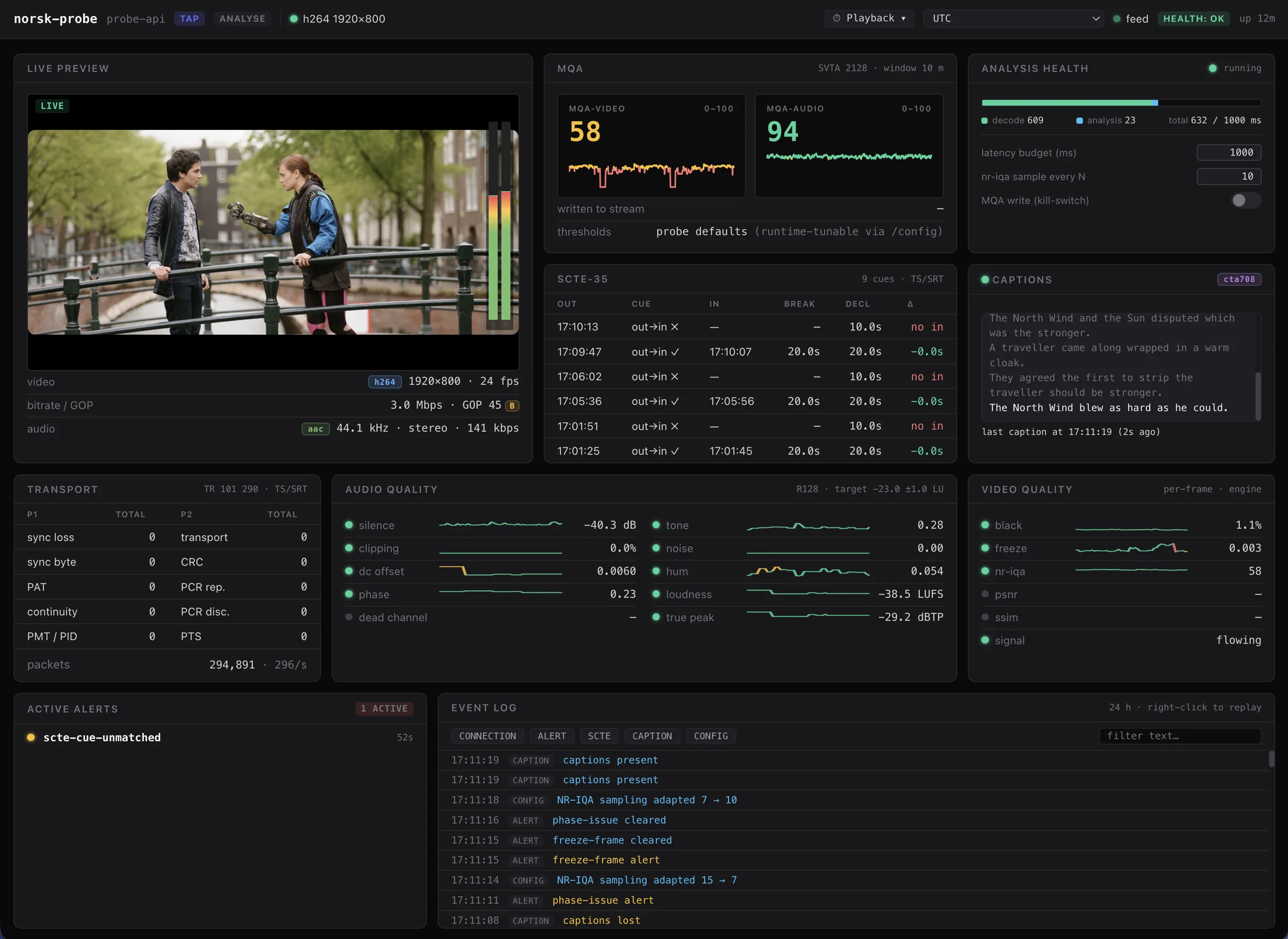
The Norsk Probe monitoring interface

How it works

Three modes. Start with the one that touches nothing.

Norsk Probe deploys in three modes, designed as a risk ladder. Begin in tap mode, where Probe cannot affect your stream. Move to inject when you're ready to write quality scores into the signal. Read those scores anywhere downstream — including past the DRM packager — with no re-analysis.

Tap mode
It cannot break your stream

Probe sits next to your signal path, not in it. Run it for a week against your real feeds. See what it catches that your current wall misses — at zero risk to anything that's working today. Keep everything you have, add Probe alongside it, and judge what it surfaces with your own eyes.

Inject mode
Write quality into the stream, bit-exact

When you're ready, switch Probe inline. The egress is a bit-exact mirror of the ingress — no transcode — with MQA quality scores written in-band as SEI metadata under the SVTA2128 specification. Bypass on fail is testable: trigger the failure mode yourself in a safe environment before any live deployment. One analysis at source; every downstream system can read it.

Monitor mode
Read quality anywhere downstream — keys never leave

Drop a monitor-mode probe at any point downstream, including past a DRM packager. Because it reads metadata not content, no decryption keys are needed. Quality scores travel with the stream, so redundancy systems can switch on a degraded picture before viewers notice — instead of waiting for a hard signal failure.

MQA ecosystem partners →

What Probe solves

The moments your current monitoring misses

Probe is bought for the situations a signal-presence wall cannot cover: the slow degradation, the finger-pointing call, the encrypted-content blind spot, and the compliance stack that doesn't talk to itself.

End the finger-pointing

Find the failing hop. End the call.

Something looks bad on air. The encoder vendor blames the packager, the packager blames the CDN, the CDN blames the encoder — and because no probe can see past its own boundary, the call goes on for an hour while the stream stays degraded.

MQA scores written in-band travel with the stream. Read quality at every hop and point at the exact transition where the picture dropped. The finger-pointing call ends in five minutes, with evidence anyone in the chain can see.

Talk to us about your chain →
Catch what's bad, not just what's dead

Switch on bad pictures, not dead signals

Your redundancy switches when a feed dies. But a feed can be technically alive and visibly broken — a frozen frame, a slowly mushing remote contributor, creeping compression artefacts — that sits on air for seconds or minutes before anything fails hard enough to trigger a switch.

MQA-annotated streams let downstream systems switch on picture quality, not just signal presence. The bad picture becomes a non-event before viewers notice it.

Talk to us about your setup →
Close the DRM blind spot

Monitor encrypted content — no keys, ever

Downstream of the DRM packager, traditional probes need decryption keys to assess picture quality. Distributing those keys to monitoring infrastructure is a compliance and security risk you don't want to design into a premium-content chain — so most chains quietly leave that section unmonitored.

Probe injects MQA quality scores upstream of the packager. Downstream monitor-mode probes read the embedded metadata to assess picture quality without decoding content. DRM keys never leave the secure packaging environment. The blind spot closes, the compliance risk doesn't open.

Talk to us about your setup →
One probe, one event log

Three compliance tools. One probe.

Broadcast compliance typically means three tools with three dashboards: audio loudness (EBU R128 / ATSC A/85), stream integrity (ETR 290), and ad-marker validation (SCTE-35/104). When the auditor asks a cross-cutting question, the tools can't answer it — they don't talk to each other.

Probe covers all three in a single deployment with a unified, time-sequenced event log. Structured event export integrates into your existing reporting stack. One integration to build, document, and hand over — instead of three.

Talk to us about your setup →

Capabilities

What sits behind the result

Probe is built to be verified by you — your hands on the API, your eyes on the wall, your bypass-on-fail test in a safe environment before anything goes near production.

Differentiator
In-band quality scores. Open standard.

MQA scores written per-frame into the stream as SEI metadata under the SVTA 'Transmission of MQA data' specification (SVTA2128, v1.0). The inject probe is a bit-exact mirror of the input — no transcode. Downstream systems read metadata, not content. One analysis at source, read anywhere — including past the DRM packager, with no keys.

Standards
Co-author of the standard, not just an early adopter

Norsk co-developed CMSD-MQA (SVTA2128) alongside Akamai, Touchstream, and G&L Systemhaus, with AWS Elemental as a fellow early adopter. The spec is formally published, not a future promise. When a vendor asks 'why should I trust your roadmap,' the answer is that Norsk helped write the standard everyone else will eventually have to support.

Integration
Full API and CLI on every function

Every detection setting, every event, every mode control — available via API and CLI, not just the UI. Configure thresholds from code, pull the structured event log into your existing alerting and analytics stack, and wire Probe into your automation without living in someone else's dashboard. If anything you need is UI-only, that's a fair reason to walk.

Detection
NR-IQA — interrogable, not a black box

Non-reference image quality assessment using broadcast-trained DBCNN and MUSIQ models. Detects subtle picture degradation — mosquito noise, blocking artefacts, compression quality drift — without a reference stream or additional infrastructure. Drill into any score and see what drove it: components, thresholds, confidence. The number isn't a black box.

Detection
Black, freeze, colour-bar, audio

Configurable threshold detection for black frames, freeze frames, and colour-bar patterns. Per-channel audio level monitoring, silence detection, and loudness measurement (EBU R128 / ATSC A/85) for broadcast compliance.

Compliance
One event log for everything compliance

ETR 290 Priority 1/2 stream compliance including PCR timing, packet loss, and decode error detection. SCTE-35 and SCTE-104 marker logging with Q-in/Q-out pairing for ad insertion validation. All three compliance types surface in one time-sequenced event log, so a loudness excursion and an ETR 290 error sharing a timestamp are visible together.

Operations
Multiview the producer can read

Browser-rendered monitor wall, available in all three modes. Per-source quality status is colour-coded and unambiguous from across a control room — situational awareness for a busy operator, not a diagnostic dashboard. MoQ transport targets glass-to-glass latency under 250 ms; WHEP sub-second. Layouts up to 8×8 with live audio meters, alert overlays, and per-source MQA scores.

Accountability
Roll back to what the audience actually saw

Rolling local buffer up to 24 hours. Jump straight to the moment a quality event was flagged and see exactly what the picture looked like at that timestamp. Export an MP4 clip for the client conversation, or the structured event log for your reporting stack. The post-show 'what happened at 8:40' question now has an answer.
Run it next to your real stream

Tap mode cannot break your signal. Stand Probe up alongside your current monitoring, see what it catches, and decide where to take it next. Book a demo to see MQA injection live — or talk to us about how Probe would fit your chain.

Book a demo Workflow engineer? See how Probe fits into a Norsk Studio pipeline →