Norsk Playout
A FAST platform slot does not wait for an engineering sprint. Norsk Playout handles the full pipeline — schedule, normalise, overrun, deliver — and a live channel from your library is running in under 30 minutes. Run it on-prem, at the edge, or in any public cloud, from a single licence — no rebuild required when your infrastructure model changes. API-driven from day one: operable by your software team without specialist broadcast operators, plugged into your existing orchestration. Cost-per-channel economics that hold at fifty channels.
How it works
The full pipeline in one workflow. The first channel proves the economics; the tenth confirms them.
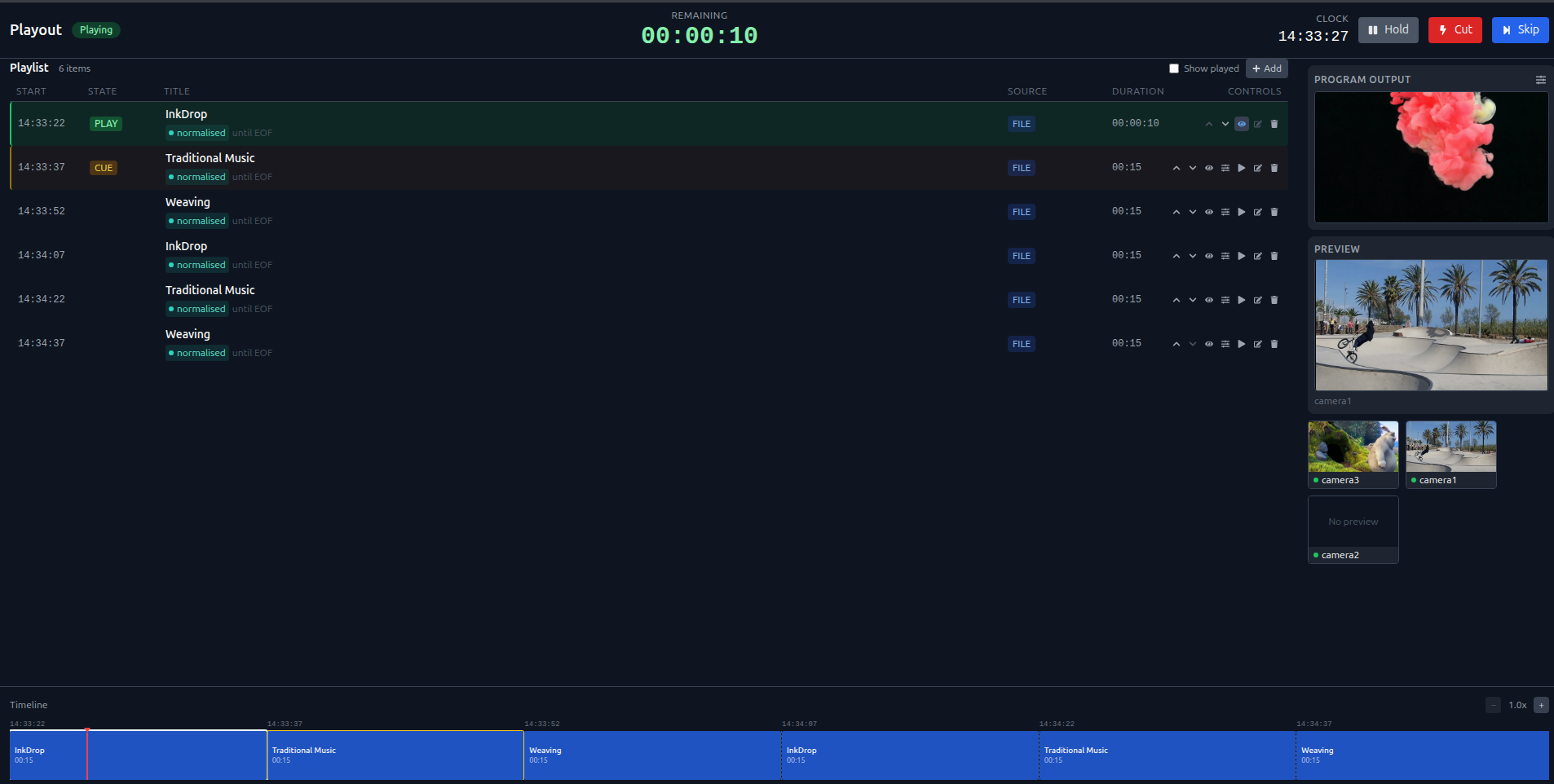
Accept pre-recorded files and live contribution feeds. Build playlists, declare schedule boundaries, and configure overrun handling strategies — catch up gradually, cut early, record and delay, or accept the slip — before air time, not during. The first channel is live in under 30 minutes with real assets, not a sample file.
Spectrum normalises every inbound file and feed to a consistent output standard: frame rate, resolution, HDR/SDR, colour space — GPU-accelerated, applied automatically. The mixed-codec library that accumulated over years of acquisition produces clean output without a preprocessing stage you have not budgeted for.
API-driven from day one — channel creation, scheduling, and configuration are all scriptable and repeatable. Output to HLS/DASH for CDN delivery or write to TAMS for regional time-shifting, all within one workflow. The marginal effort per additional channel genuinely decreases as the pattern repeats. That is the economic story the business case is built on.
About TAMS →Use cases
The operations that benefit most are those where channel ambitions are outrunning what the infrastructure can deliver — on time and at sustainable cost.
A streamer's BD team commits to a FAST platform partner: three channels live in six weeks. Their previous approach would take four months minimum. The infrastructure is the reason the business cannot make commercial promises it is obviously right to make.
A live channel from the library in under 30 minutes. The tenth channel costs a fraction of the first to stand up — confirming the economics before the client's next distribution conversation. The BD team's next pitch starts from 'we can have that live in three weeks,' not 'let me check with engineering.'
Talk to us about your distribution timeline → Case study: G&L's multi-tenant playout platform →A regional sports broadcaster's live events regularly run 30 or more minutes past their declared end — directly into hard-boundary news and prime-time programming. Managing the handover requires an operator in the room, manual judgement calls under time pressure, and a constant risk of putting the wrong content on air.
Overrun strategy declared once in the workflow: catch up gradually, cut early, record and delay, or accept the slip. The boundary holds without someone in the room making decisions against a clock. The operator's job becomes reviewing what happened, not managing it in real time. For teams that want the system to flag the overrun risk before it happens, Norsk Reasoning adds schedule alerting and content-cued switching on top of the same workflow.
Talk to us about your workflow → Add schedule alerting with Norsk Reasoning →Replacing national content with a time-shifted regional replay traditionally requires a separate recording chain, a store, and a managed delayed playback system — three systems, three failure modes, three operations teams.
Norsk Playout captures national content to TAMS during the regional slot and replays it on delay — all within one workflow. Content is accessible the instant it is captured. No file transfers, no separate delay chain, no dedicated hardware for the regional operation.
Talk to us about your requirements →Capabilities
The full playout stack — API-driven, self-healing, built on the operational discipline behind hundreds of 24/7 linear channels at scale.
Co-located pipeline stages move uncompressed video through shared memory instead of across network transport, eliminating the encode/decode and transfer overhead most playout systems pay even between components running on the same box. Sub-millisecond intra-server movement, deployable anywhere Norsk Playout runs.
API-driven channel creation and scheduling means each additional channel costs less to stand up than the last. Build once; the pattern repeats. The per-channel operational load improves at scale — not just the infrastructure cost. Channel creation, scheduling, and configuration changes are all scriptable, so the team running ten channels is the same team that can run fifty.
Sub-second cloud failover when an instance fails. The failover behaviour is deterministic and deliberately testable — you can see exactly what happens to your channel output when a source drops, before you stake an operation on it.
Most playout systems treat the schedule as a static playlist, parsed once at the top of the hour — any live deviation needs a human in the MCR to intervene. Norsk Manager rewrites the active pipeline graph in real time instead. Four configurable overrun strategies — catch up gradually, cut early, record and delay, or accept the slip — declared in the workflow before air time, not negotiated manually by an operator racing a clock. Live events that run 40 minutes long do not require someone in the room to manage the handover.
Capture national content to TAMS during the regional slot and replay it on delay, all within one workflow. No separate recording infrastructure, no file transfer wait. TAMS is an open standard shaped by BBC R&D; Norsk Playout is built by the engineers who helped define it.
Spectrum normalises all inbound content — library files, live feeds, contribution sources — to a defined output standard: frame rate, resolution, HDR/SDR, colour space. GPU-accelerated, applied automatically. The mixed-codec library accumulated over years of acquisition produces clean output without a preprocessing stage you have not budgeted for.
Full API surface from day one. Channel lifecycle operations — creation, scheduling, configuration, monitoring — integrate with existing automation and observability stacks. A software team can run the channel operation without specialist broadcast expertise. No dedicated hardware UI required.
Talk to us about your channel count, your distribution timeline, and your infrastructure model — and we'll walk through what the economics look like at the scale you're heading toward. Or start a trial and see how quickly your library becomes a live channel.
Talk to Us