Multi-platform delivery
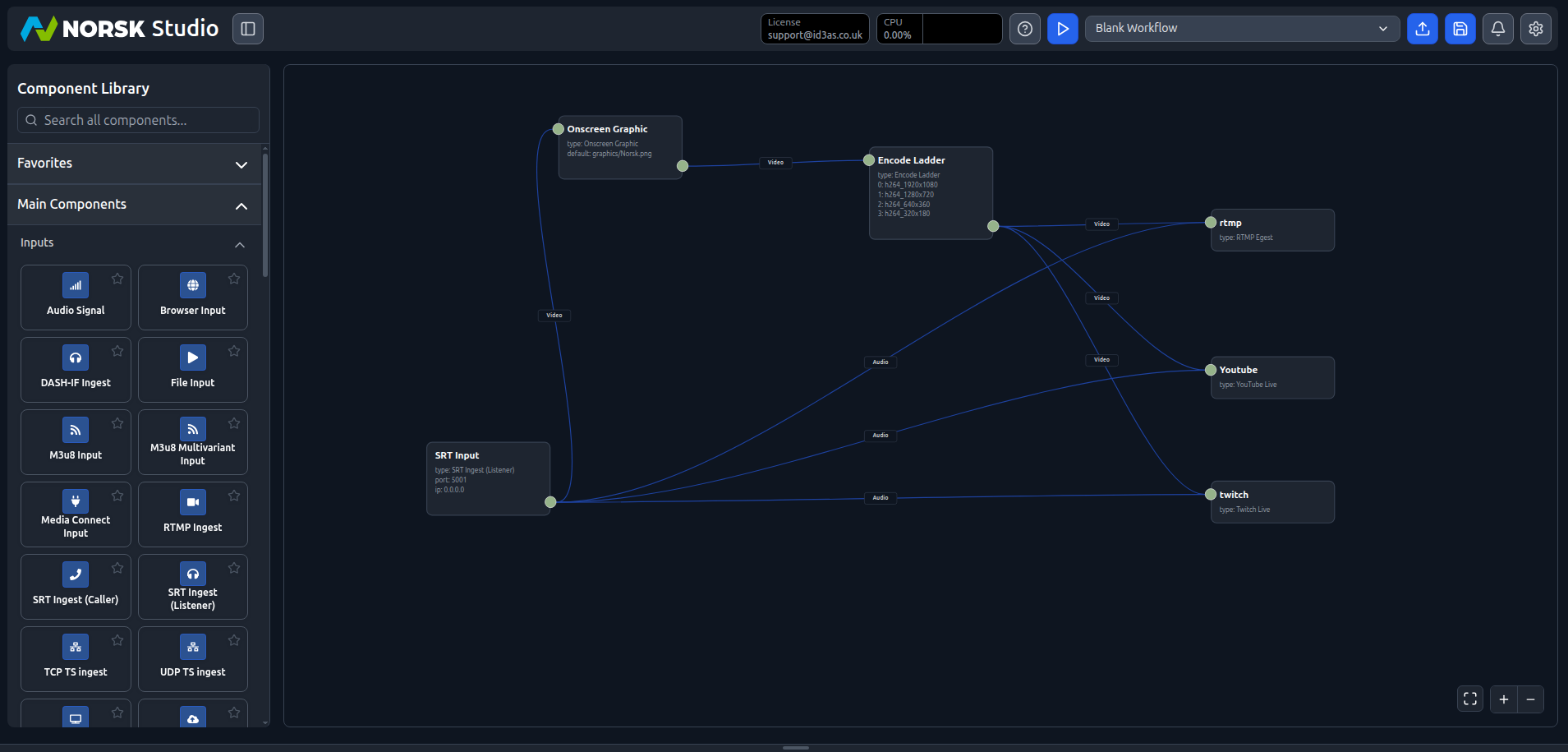
Going out to your own CDN, YouTube, Twitch, and three social platforms usually means a stack of encoders — one per destination, each with its own ingest, its own bill, and its own way of failing. Norsk fans out from a single workflow: one ingest, one encode, every destination in parallel. Adding a platform is a node on the canvas, not another box in the rack.
How it works
Destinations are outputs on the same canvas, all fed from the same encode — so the cost of the fifth platform is a node, not a pipeline.
fixedLadder encodes a single video stream into multiple renditions at different resolutions and bitrates, and every output downstream draws on that same ladder. You're not paying to encode the same content once per destination — which is exactly what a stack of per-platform encoders makes you do.
See hardware acceleration →Norsk has dedicated outputs for YouTube, Twitch, Facebook, and LinkedIn — each one streaming to several channels or destinations at once from a list of stream keys. The YouTube output sends to both the primary and backup ingest servers for every key, so the redundancy those platforms expect is the default rather than something you remember to wire up. For anything else, the generic RTMP output sends to one or more remote servers simultaneously.
The social fan-out runs alongside your own distribution, not instead of it. autoCmaf builds CMAF outputs with segmenting, S3 publishing, and ad insertion support; autoHls produces HLS with Transport Stream segments; SRT and UDP-TS feed affiliates and contribution paths; WHEP and MoQ cover the sub-second cases. Same workflow, same encode, different shapes on the way out.
See low latency delivery →Use cases
Simulcasting is easy to do badly — the hard part is doing it without multiplying your infrastructure by the number of platforms.
A live show needs to reach YouTube, Twitch, and LinkedIn simultaneously, plus the organisation's own player. Doing that with a cloud encoder per platform means paying to encode the same content four times over, and four places to look when one destination stops.
One workflow ingests once, encodes once, and fans out to all four in parallel — dedicated outputs for the platforms, CMAF or HLS for the owned player. Add the fifth platform by dropping in a node with its stream key.
Talk to us about simulcasting →A broadcaster has to feed affiliates over SRT or UDP-TS, publish ABR to a CDN, and push a social simulcast — three different delivery philosophies that normally live in three different systems that all have to agree.
All three are outputs on the same workflow. Contribution over SRT and UDP-TS, packaged CMAF or HLS to the CDN with S3 publishing, and the social outputs alongside — all from one encode, so the versions can't drift apart.
See formats & codecs →A platform running many concurrent streams needs each one going to the same set of destinations, configured the same way. Per-stream manual setup is where inconsistency and mistakes come from.
The fan-out is part of the workflow template, so every stream that runs inherits the same destinations and the same redundancy. Save it once; the hundredth stream publishes exactly like the first.
Talk to us about scaling delivery →Capabilities
Four things to understand about how Norsk publishes to many places at once.
Purpose-built outputs for YouTube, Twitch, Facebook, and LinkedIn, each streaming to multiple channels or destinations from a list of stream keys. YouTube goes to primary and backup ingest servers per key automatically; anything else is covered by the generic RTMP output.
autoCmaf creates CMAF outputs with segmenting, S3 publishing, and ad insertion support. autoHls produces HLS with Transport Stream segments. Multivariant playlist components assemble and publish the ABR manifests over the top.
fixedLadder builds the rendition ladder once and every output draws from it, rather than each destination triggering its own encode. Combined with NVENC or NETINT acceleration, that's the difference between one machine and a rack of them.
SRT and UDP-TS for affiliates and contribution, WHEP and MoQ where sub-second latency matters, RTMP for everything conventional. Social simulcast and serious distribution come out of the same chain instead of separate systems.
Whether you're simulcasting to social, feeding affiliates and a CDN from one chain, or scaling a fleet of concurrent streams, get in touch and we'll map it to your destinations.
Talk to us