Norsk Manager

Norsk, running anywhere. One API across cloud, hybrid, and on-prem.

Norsk Manager is the deployment and orchestration layer for Norsk Media. It lets you run Norsk SDK or Studio workflows on any infrastructure — public cloud, on-premises hardware, or a hybrid combination — and manages the details: node inventory, workload scheduling, payload packing, and status monitoring. One API regardless of where Norsk is running.

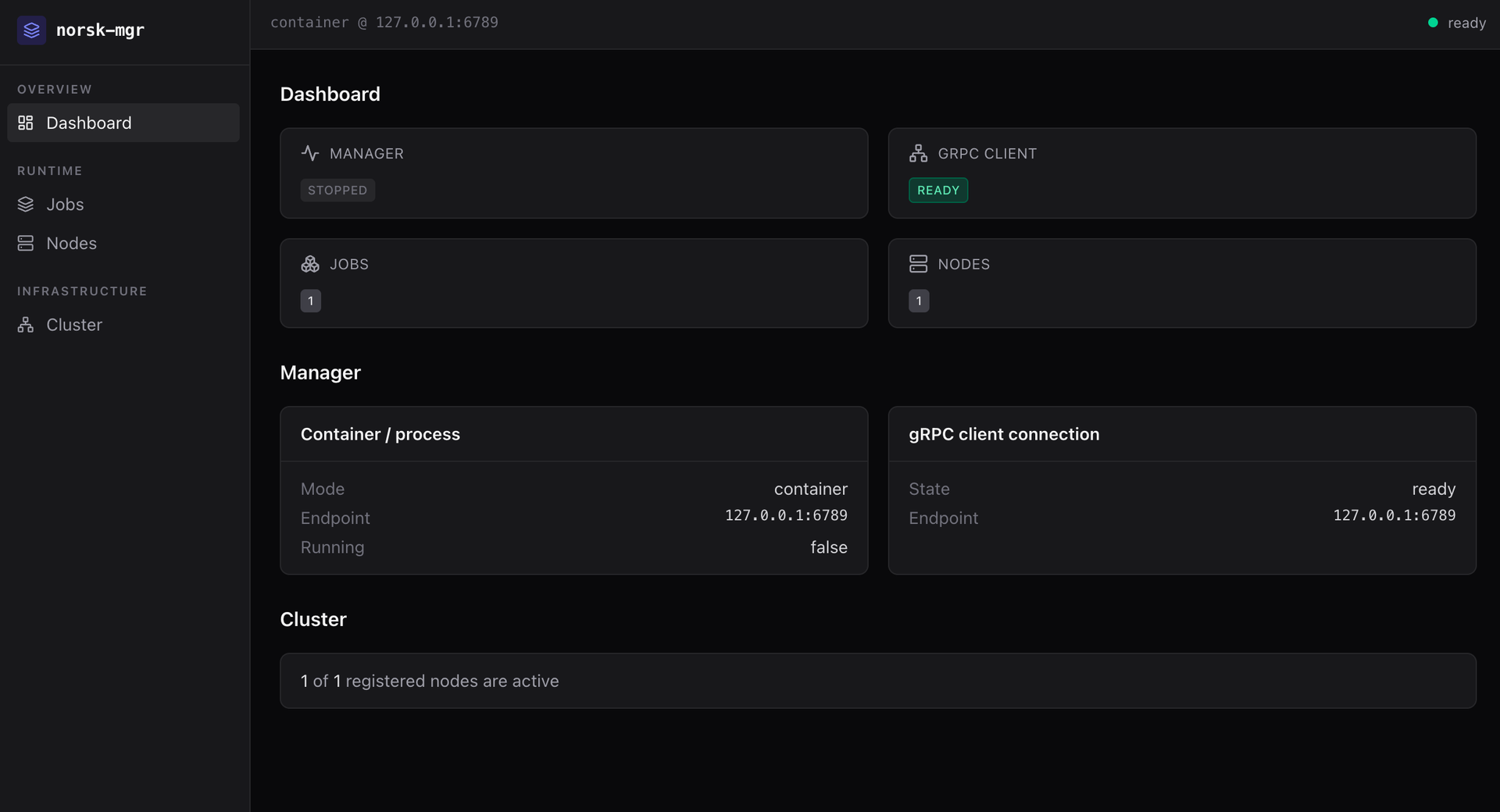
The Norsk Manager console: node inventory, workload scheduling and status monitoring across cloud, hybrid, and on-prem infrastructure

How it works

Register. Deploy. Monitor.

Three operations that cover the full lifecycle of a Norsk deployment at scale.

Step 01
Register your infrastructure

Add the nodes you want Norsk to run on — cloud instances (AWS or OCI), on-premises servers, or a mix. Norsk Manager inventories your hardware and understands what each node can do: CPU cores, GPU availability, memory, and capacity for concurrent workloads. Heterogeneous environments are not a special case; they are the default assumption.

Manager SDK docs →
Step 02
Create and deploy jobs

Submit a job via the TypeScript SDK or gRPC API — a Norsk Studio workflow or an SDK-built pipeline. Manager schedules it onto the right node for its hardware requirements and packs multiple payloads per server, maximising utilisation without requiring you to manage capacity by hand. The same API works whether the target is a cloud instance or a bare-metal server in your data centre.

Manager gRPC API →
Step 03
Monitor and scale

Track the health and status of every deployment through the unified API — job state, node health, event streams, and audit history. Add capacity by registering more nodes. Remove capacity by draining and deregistering. The API surface is consistent regardless of which cloud provider or on-premises hardware sits underneath.

Manager starter kit →

Who uses it

From a single venue to thousands of concurrent events

Norsk Manager is the operational layer for any deployment of Norsk Media that needs to run at scale, span multiple environments, or make efficient use of mixed hardware.

Cloud broadcaster

Hundreds of concurrent events without per-event infrastructure management

A streaming platform needs to run hundreds of simultaneous live events on cloud infrastructure — different workflows, different resource requirements, varying event schedules. Managing capacity manually at that scale means either over-provisioning or constant ops overhead tracking what is running where.

Norsk Manager handles scheduling and placement. Jobs land on nodes with the right capacity; multiple payloads pack onto each server so capacity is used efficiently. The platform team submits jobs and monitors status via the API — they are not managing individual instances. Event scale grows without operations overhead growing with it.

Talk to us about your scale →
Hybrid operator

On-prem for the regular schedule, cloud for the peaks

A broadcaster runs their regular channel slate on owned hardware but needs to burst to cloud for major events without rebuilding their orchestration layer. The workflows are the same; the infrastructure differs. Managing two separate control planes means operational complexity that doesn't go away when the event ends.

Norsk Manager presents the same API regardless of whether nodes are on-prem or cloud. The broadcaster registers both in the same inventory. Workflows deploy to on-prem nodes for regular operations; cloud nodes absorb burst capacity during major events. One API, one view of the deployment, regardless of what is running where.

Talk to us about your hybrid setup →
Mixed-hardware environment

Getting the right workloads onto the right hardware automatically

An operator's server fleet is a mix of GPU-equipped machines for transcoding-heavy workloads and CPU-only nodes for lighter processing. Scheduling manually — deciding which job goes on which hardware type — is feasible at a small scale. At dozens of servers and hundreds of jobs it becomes a constraint that limits how quickly new events can be brought online.

Norsk Manager understands the capability profile of each registered node. Jobs that require GPU acceleration land on GPU-equipped servers; jobs that don't free up that capacity for workloads that need it. The operator submits jobs without specifying hardware; Manager handles placement. The fleet runs at higher utilisation without manual scheduling overhead.

Talk to us about your infrastructure →

Capabilities

The operational layer Norsk needs at scale.

Norsk Manager handles the infrastructure concerns so your team focuses on the pipelines.

Anywhere
Cloud, on-prem, and hybrid from one API

Register cloud instances (AWS, OCI) and on-premises servers in the same node inventory. Deploy jobs to any of them through the same API surface. The orchestration layer abstracts the infrastructure difference — Norsk SDK and Studio workflows run without modification regardless of where they land.

Packing
Multiple payloads per server

Norsk Manager places multiple live pipelines on each server and manages the capacity accounting. You do not need to pre-allocate one pipeline per instance or manage utilisation by hand. More jobs per server means lower infrastructure cost per event and simpler capacity planning at scale.

Hardware
Heterogeneous hardware awareness

Node registration captures the hardware profile of each server: CPU cores, GPU availability, memory, and concurrent workload capacity. Manager uses that profile for placement — GPU-accelerated workloads go to GPU-equipped nodes; lighter jobs go where capacity exists. A mixed fleet operates at higher utilisation without manual scheduling decisions.

API
TypeScript SDK and gRPC API

The full Manager surface is available via a TypeScript SDK and a gRPC API — create jobs, update deployments, drain nodes, query status, and subscribe to event streams. Integrate Manager into your existing orchestration and monitoring systems using whichever interface fits your stack.

Monitoring
Deployment status and event streams

Track job state, node health, and deployment history through the API. Subscribe to event streams for real-time status updates. Audit logs capture the history of every create, update, and delete operation. The information needed to operate Norsk at scale is surfaced consistently, not scattered across per-instance dashboards.

Scale
From tens to thousands of concurrent events

Norsk Manager has a long production history running concurrent live events at scale — the same API that manages ten simultaneous events manages a thousand. Add capacity by registering nodes; remove it by draining them. Scaling does not require changes to how you submit jobs or monitor deployments.
Norsk at the scale your operation requires.

Norsk Manager is available as part of an enterprise arrangement. Talk to us about your deployment scale, infrastructure model, and what operational requirements you need covered.

Get in touch