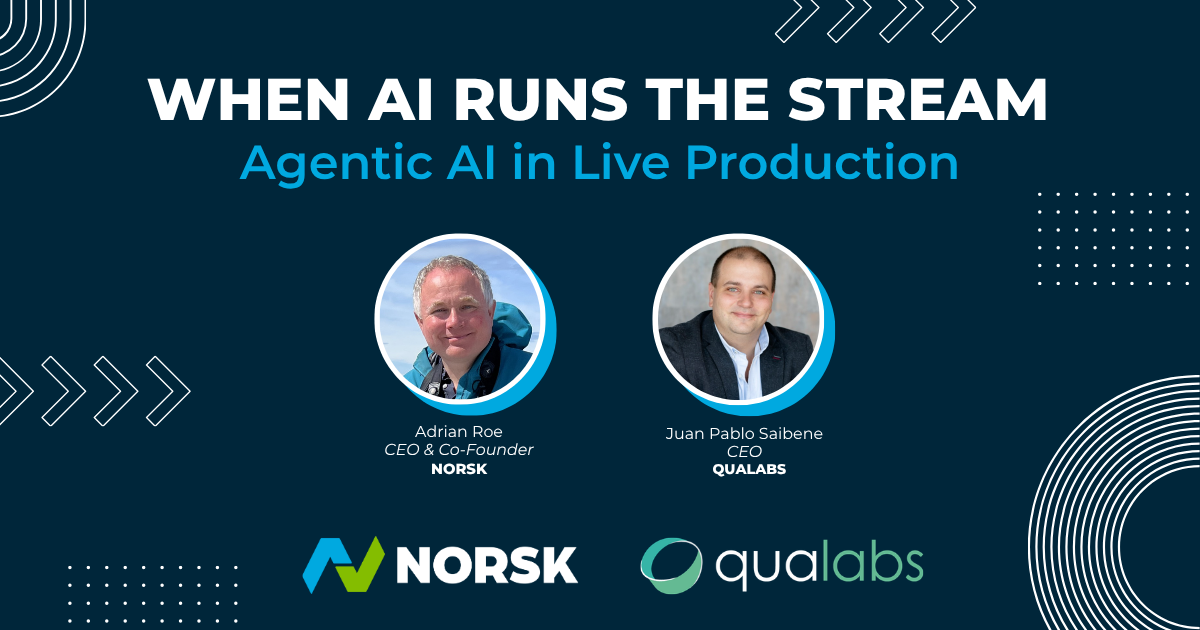
According to Norsk CEO Adrian Roe in our recent “When AI Runs the Stream” webinar with Qualabs, the question everyone is asking about agentic AI in live production is the wrong one. The question isn’t whether AI is “ready,” but rather what jobs it is actually suited for. That distinction matters, because it’s the difference between deploying AI strategically and deploying it because a vendor’s ad promised it would “AI your AIs.”
Start with what’s already solved
Roe walked through a rough hierarchy of AI readiness in live streaming, and the floor of that hierarchy is more or less settled. Transcription and translation are largely solved problems — the historical bias toward English and Latin-based languages has faded, and speech-to-speech translation that preserves a speaker’s emotional register is moving from experimental to realistic. Regulatory pressure is accelerating this, as mandatory subtitling requirements in markets like the US and UK are forcing the issue. (You can learn more about captioning and subtitling with AI in our previous webinar, “Context Is King”.)
One tier up sits monitoring and quality, and here Roe identified the actual criteria that make a task a good AI candidate, not just a plausible one. The intervention triggers human involvement rather than replacing it, and so the cost of a wrong call is low. Quality-based source switching is his clearest example: If an AI misjudges signal quality and switches from a fine feed to another fine feed, nobody notices. That asymmetry is what makes AI appropriate, not the sophistication of the model behind it.
Cheap mistakes, narrow problems
Perhaps the key point Roe suggested was to frame the problem as narrowly as possible, and make the mistakes cheap. Automated SCTE marker insertion for monetizing tier-3 and tier-4 content only works because a late halftime detection by a few seconds doesn’t ruin a 30-second ad break. He contrasted that with a fencing example where an AI system framed a static poster of two fencers as the live action, because the problem was left too open-ended and the cost of getting it wrong was high. AI performs best when the task is bounded and forgiving, not when it’s asked to solve for everything at once.
Roe was equally direct about cost. Sending raw video frames to an LLM is expensive and slow, often 2 to 10 seconds of round-trip latency. Sending only object locations detected locally, and reserving the LLM for judgment calls, can cut token usage by one or two orders of magnitude while improving output quality, since the model isn’t reasoning over irrelevant pixels. His broader point was that you should treat cost as a first-class design constraint from day one, not something to discover in an invoice. He drew a direct parallel to early cloud migrations, where naive per-server estimates ignored ingress, egress, and storage until the real bill arrived.
Trust is earned, not switched on
Juan Pablo Saibene of Qualabs brought the operational counterpart to Roe’s technical framing.. Saibene’s team builds systems as a funnel: deterministic threshold detection first, pattern-matched root-cause analysis second, and only as a last resort for genuinely novel problems, an LLM. When the model does surface a new issue, an engineer approves it, and from that point forward the same incident resolves deterministically, without touching the LLM again. As Saibene put it, the goal isn’t to use a human as a safety net but as a mechanism for converting judgment into determinism over time.
Roe echoed this on the trust question directly, saying that AI gives you “what” but rarely the “why,” and the “why” is usually reconstructed after the decision was already made. That’s a hard sell when a customer wants to know why a stream cut away from a scoring play. Both speakers agreed on the answer — audit trails, incremental trust-building, and human-in-the-loop review as the price of admission, not a temporary crutch.
The takeaway
AI is appropriate when a problem can be narrowly scoped, when errors are cheap, and when the economics have been modeled rather than assumed. And the value isn’t in the model, but in the orchestration around it, and handing that orchestration layer to a vendor means renting back your own workflow. For production teams evaluating where AI actually belongs in their pipeline, that’s a far more useful test than asking whether the technology is ready.
Watch the full webinar below, and get in touch to learn more about how Norsk can help you integrate agentic AI in your live productions.