Live broadcast production involves a set of specialized functions, often handled by different vendors. Pictures come in from cameras, replay servers, and remote feeds. They are switched and mixed, layered with graphics and captions, checked in monitoring, then encoded and delivered to consumers. Each function must reliably hand off video, audio, and ancillary data to the next with minimal delay.
For decades, the broadcast industry has connected these services with SDI. A single coaxial cable carries uncompressed video, embedded audio, and ancillary data such as captions and timecode with near-zero latency, and any camera, router, vision mixer, or monitor can connect to any other.
With the industry's move to IP, SMPTE ST 2110 kept SDI's core strengths while removing its one-cable-per-signal model. Media travels as precisely timed streams over standard IP networks so that signals can be routed flexibly through commodity switches instead of dedicated SDI routers.
Yet both standards depend on moving media between separate boxes, over cables or network links. ST 2110 achieves its guarantees using engineered network infrastructure, precise PTP timing, and dedicated NICs. That is the right trade for a facility full of hardware, but not when the functions are software running on the same server.
Increasingly, they are. Vision mixing, graphics, captioning, encoding, replay and quality control operate as software instances hosted on standard servers or in the cloud. Facilities can launch them for a single event, scale them on demand and tear them down when finished.
However, exchanging media across multi-vendor software applications has lacked a universal, platform-agnostic handoff mechanism analogous to SDI. Consequently, even when processes run on the same server, architectures pass media between them as network traffic: NDI, compressed streams over SRT, or uncompressed ST2110 through dedicated network cards. These intermediate steps add cost, delays, increase CPU load, degrade video quality, and often require dedicated integration work for each vendor connection.
This is where the Media Exchange Layer (MXL) comes in. It aims to do for software what SDI did for appliances: give every vendor the same simple, neutral way to connect to the next.
What is the Media Exchange Layer (MXL)?
MXL is an open-source SDK for exchanging media between software components via shared memory. Instead of each application sending the next a copy of every frame, applications share memory. A producer writes video frames into shared memory, allowing multiple consumers to access the data directly. This model preserves quality and eliminates packetization between processes hosted on the same system.
The idea itself is not new - applications on the same machine have long shared memory. What MXL adds is a common agreement on how media is laid out in that memory, how it is identified, and how it is timed. Further, it even adds a common implementation that vendors can easily integrate with. In that context, a graphics engine from one vendor can read the output of a vision mixer from another without either of them knowing anything about the other's internals.
How MXL works
Domains and flows
MXL organizes media into flows. A flow is a single stream of video, audio, or ancillary data, such as a camera feed, a program output, or a caption track. Each flow has a unique identifier and a descriptor that specifies what it contains: its format, resolution, frame rate, and so on. The descriptor follows the flow model from NMOS IS-04, part of the AMWA's Networked Media Open Specifications, which broadcasters already use to describe and discover media on ST 2110 networks.
Flows live inside a domain. A domain is a region of shared memory, usually backed by a memory-mapped filesystem. Any application with access to the domain can find a flow by its identifier, read its descriptor, and start consuming it. In a containerized deployment, you can mount the domain into several containers on the same node. There’s no compression or network hop between the containers. Each one maps the same shared-memory domain and reads or writes grains.
Grains and ring buffers
Inside a flow, media is held in a ring buffer. Video and ancillary data are discrete flows, stored as grains. Each grain holds one frame or one field, or one packet of ancillary data. Audio is a continuous flow, stored as a running buffer of samples rather than as separate units.
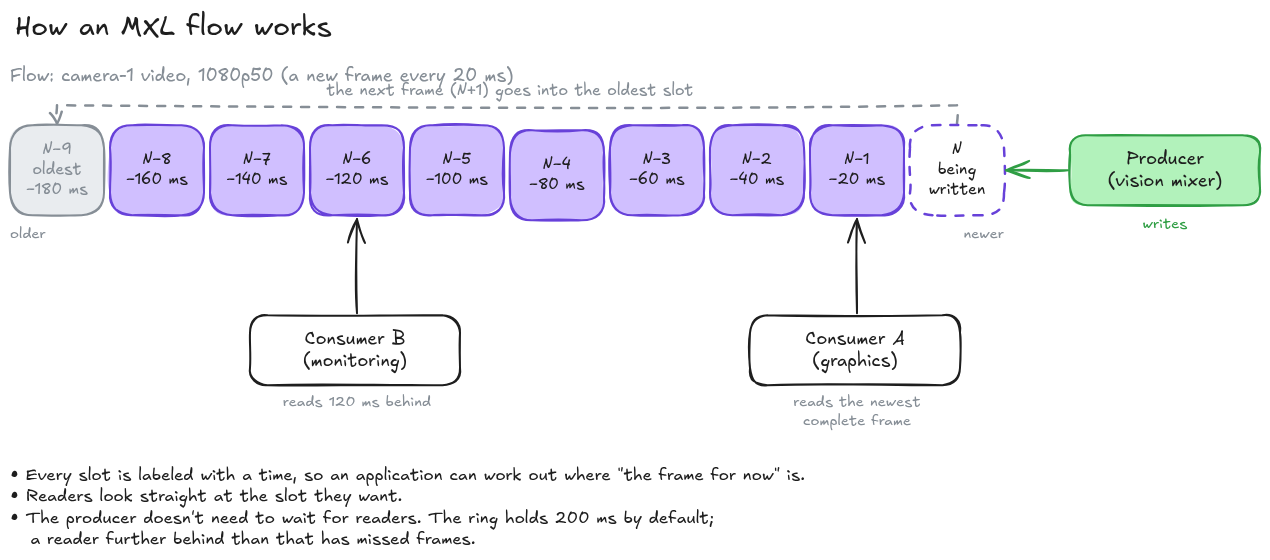
The formats are deliberately close to SDI and ST 2110. Video is v210, the 10-bit 4:2:2 layout long used by SDI capture cards, with an alpha variant for fill-and-key graphics. Audio is 32-bit floating point, one buffer per channel. Ancillary data follows SMPTE ST 291 in the same form ST 2110-40 uses, so captions, timecodes, and SCTE-35 markers carry across unchanged. Bridging video and audio to an ST 2110 network still means repacking samples, but it's a simple format change, not a transcode.
Time as the index
An important design choice in MXL is how readers find media. Grains are not handed from producer to consumer through queues or acknowledgments. Instead, time addresses every grain.
A flow's grain index is derived from the current time, measured from the SMPTE (PTP) epoch, and the flow's rate. A 50 fps flow has a new index every 20 ms. The producer and each consumer work out the index from the same clock, so a consumer that wants "the frame for now" knows exactly which slot in the ring buffer to read.
This puts MXL in the same timing world as ST 2110. Timestamps mean the same thing whether media is in a shared-memory domain or on the network, and flows from different producers line up naturally.
Writers don't wait for readers
The producer writes grains into the ring buffer at its own pace and never waits for consumers. A slow or crashed consumer cannot hold up the producer or any other consumer. A new consumer can attach to a running flow at any moment and start reading from the current grain.
Consumers don't have to keep polling for new frames. MXL provides a lightweight notification mechanism, so a reader waiting for a grain wakes as soon as the writer commits it. Writers can also commit a grain in parts, slice by slice, so a downstream function can start on the top of a frame before the bottom has been written. Where latency matters, this saves time by fractions of a frame.
What MXL is not
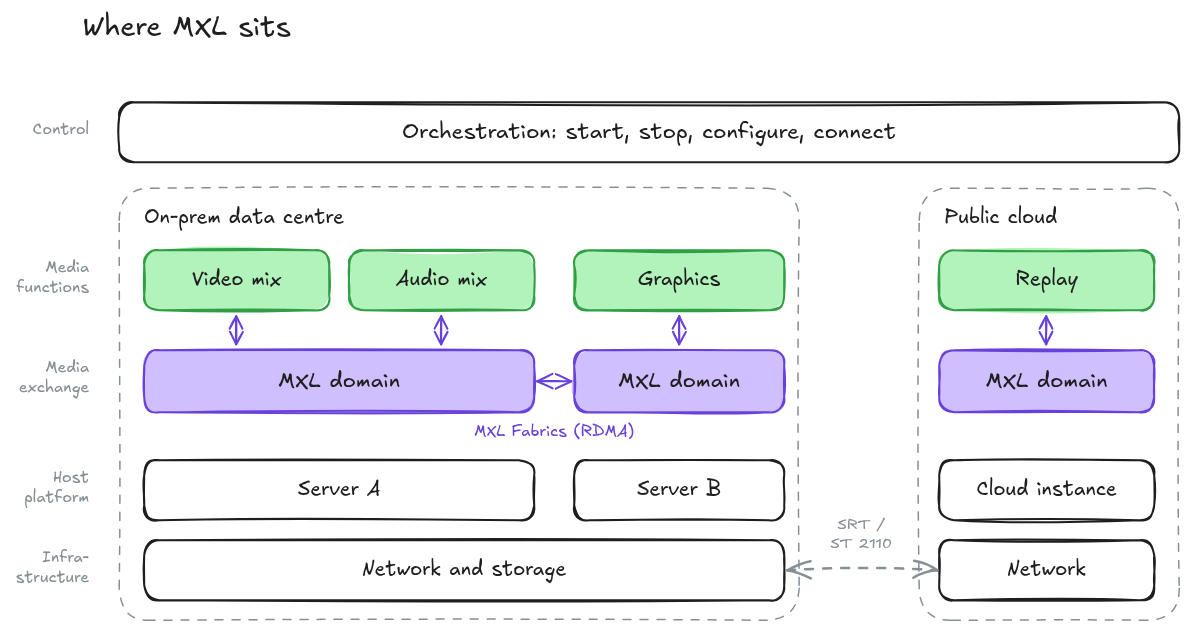
MXL is not a network protocol. It is designed for exchange within a host, where applications share memory directly. However, MXL provides Fabrics, an API that carries a flow from a domain on one server into a domain on another, frame by frame. Applications on the receiving server read it exactly as they would a local flow.
Fabrics can run over ordinary TCP, but it is designed for RDMA (Remote Direct Memory Access), where the network card writes each frame straight into the other server's memory without the CPU on either side touching the data. Uncompressed video is heavy (1080p50 needs over 2 Gbit/s), so Fabrics suit servers in the same rack or data center on fast links. Between facilities, between sites and out to the cloud, media still typically travels in a compressed contribution format such as SRT or Media Over QUIC.
It is not a control system either. MXL doesn't decide which flows connect to which applications. That remains the job of orchestration and control layers such as NMOS IS-05, or whatever a facility uses to set up its workflows. MXL only ensures that once a connection is established, the media moves efficiently and predictably.
Why it matters
For vendors, MXL offers a single integration target. Supporting MXL once means interoperating with every other MXL-capable application. Today, each vendor pairing needs its own bespoke integration work.
For broadcasters, it changes the economics of software production. Media moves between functions without encoding, packetizing, or copying, so CPU and memory bandwidth that once went on moving pixels around can go on processing them. Video stays uncompressed from start to finish, and latency between functions drops. Because flows are discovered and attached at runtime, a production can add a graphics instance or a monitoring probe for a single event and remove it afterward without affecting other services.
MXL in Norsk
Norsk can both read and publish MXL flows. In Norsk Studio, that's two components: MXL ingest and MXL egest. They sit in a workflow like any other source or destination, so an MXL flow can be switched, mixed, overlaid, encoded, and delivered with the rest of Norsk's toolset.
The two Norsk Studio workflows below use MXL to pass media between separate functions through a shared memory domain. Each is a single channel doing a single job, and they never connect directly: the MXL domain is the only thing they share.
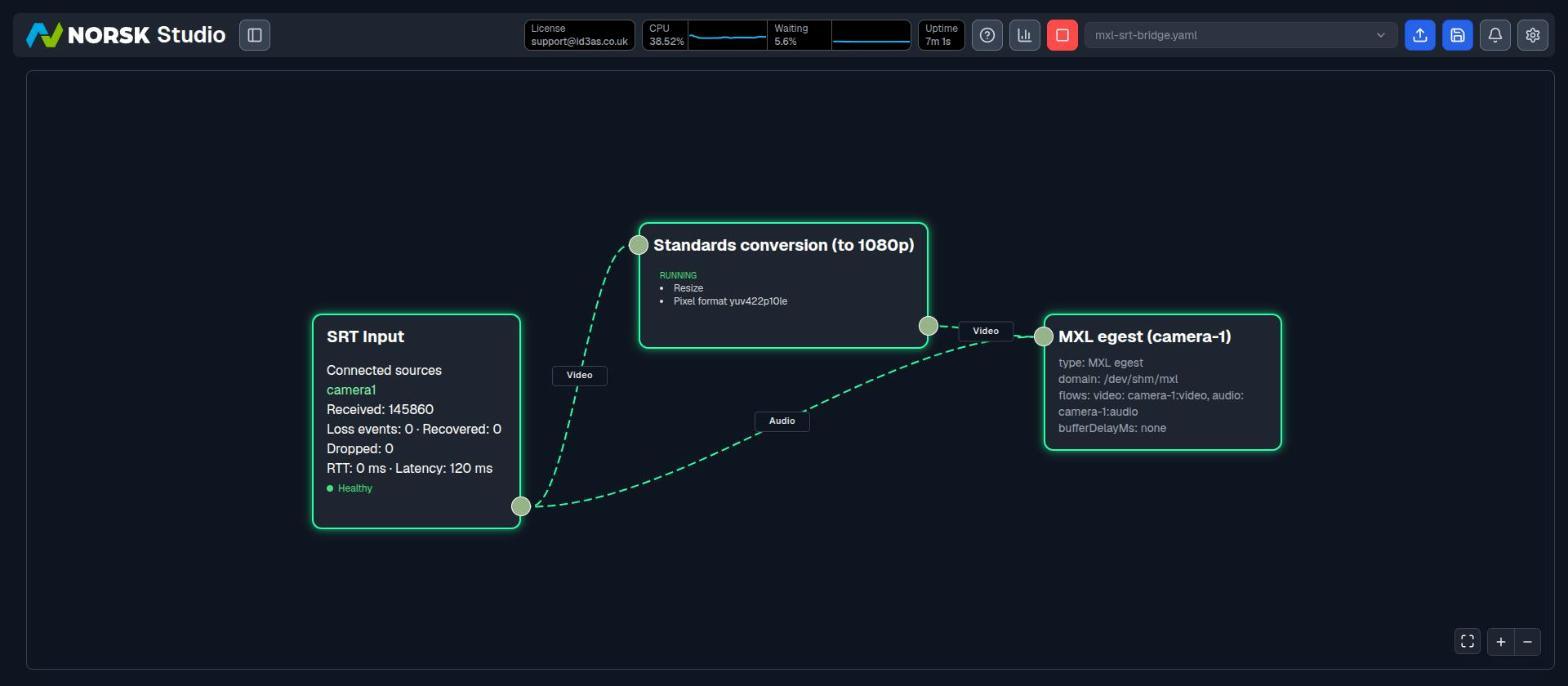
The first is an SRT-to-MXL bridge. It receives a camera feed over SRT, converts it to 1080p, and uses MXL egest to publish the video and audio into the domain as camera-1.
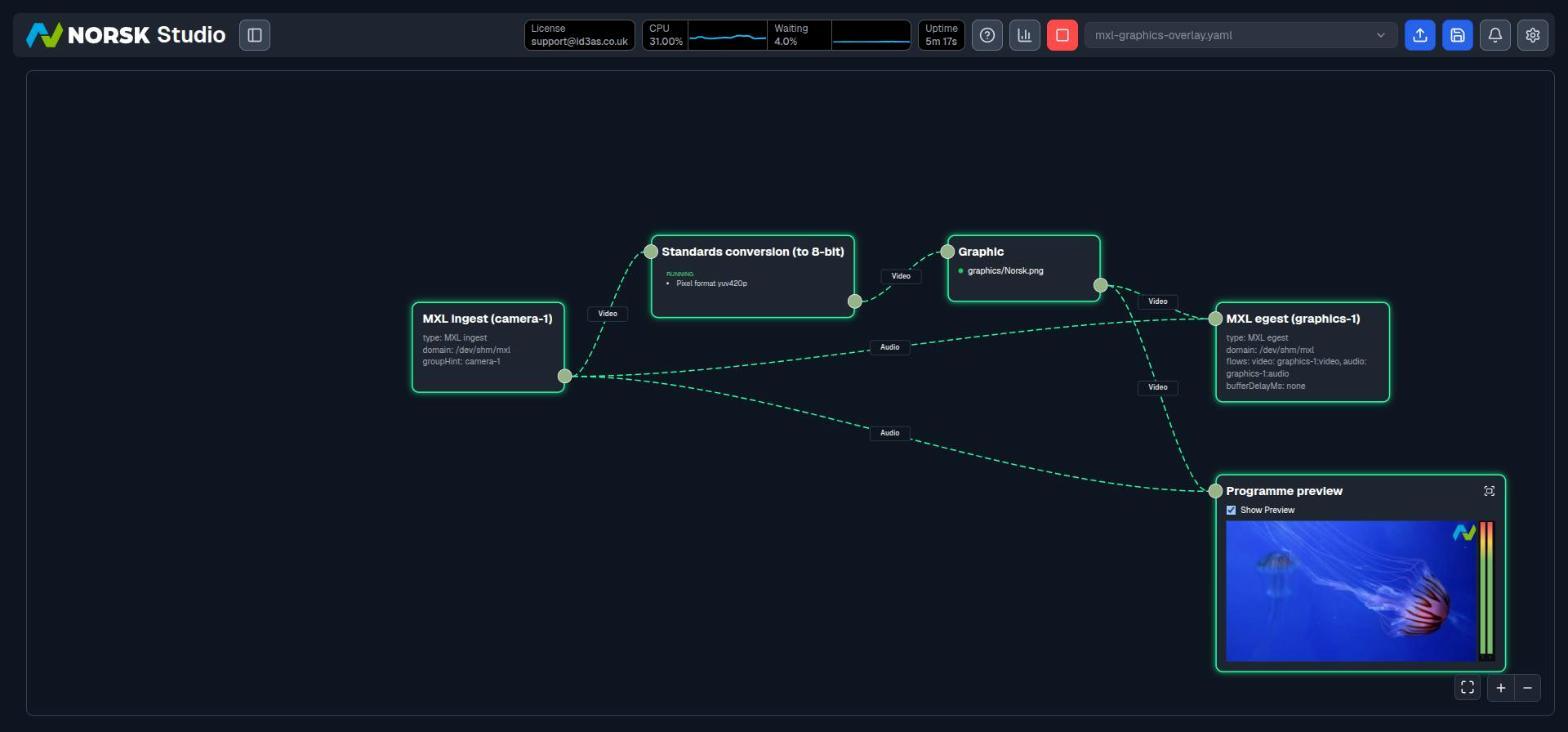
The second is a graphics overlay. MXL ingest reads camera-1 from the same domain and passes the video to a graphics engine, which adds a logo. MXL egest publishes the result back into the domain as graphics-1, ready for the next function downstream, and a preview lets the operator monitor the output.
Conclusion
MXL provides an efficient, uncompressed media interchange for multi-vendor software production. At Norsk, we believe that MXL has the potential to become the standard for live media exchange between software applications, much as SDI became the standard between hardware devices. Norsk already uses MXL in production for some of our customers, and we would welcome the opportunity to demonstrate how it can enhance your workflows.